
By: Anniina Raitila and Alison London
Suomennos: Tutustutaan: Anniina Raitila, tutkijatohtori Kasvaingenomiikan tutkimusryhmässä!
Hi! Can you introduce yourself!
I’m Anniina Raitila and currently working at Lauri Aaltonen’s Tumor Genomics group. I joined the group as a Postdoctoral Researcher in September 2023, focusing on uterine leiomyomas research.
Can you tell me a little about your background?
My career in the Tumor Genomics group started as a trainee in January 2001. After my dissertation in December 2009, I was on parental leave for almost 6 years followed by almost 8 years in a medical technology company.I have studied biotechnology (engineer & M.Sc.), genetics (Ph.D.), and pedagogy for adult education.
What did you work on during your PhD?
I studied genetics and my thesis was the role of genes predisposing to pituitary adenomas.These tumors are common, benign neoplasms accounting for approximately 15% of all intracranial tumors. Accurate incidence estimation is challenging since a great portion of these adenomas are small and asymptomatic. Clinically relevant adenomas, that cause symptoms due to the expansion of the cell mass or the over-secretion of normally produced hormones, occur in approximately one of 1 000 individuals.
Most pituitary adenomas are sporadic (no history of familial susceptibility), but a minority occur as components of familial syndromes, such as Multiple Endocrine Neoplasia type 1 (MEN1) and Carney complex (CNC).
A little earlier before my thesis work, we identified a new familial syndrome (i.e. the Pituitary Adenoma Predisposition or Familial Isolated Pituitary Adenomas) from a defined and homogeneous population from Northern Finland. This rare condition is caused by aryl hydrocarbon receptor-interacting protein (AIP) gene mutations, and it accounts for 2-4% of all patients with pituitary adenomas. Most of the patients have a growth hormone secreting tumor.
After your PhD you went to work in a medical technology company, can you tell me about your role there and what the experience was like? What sort of things were you doing there?
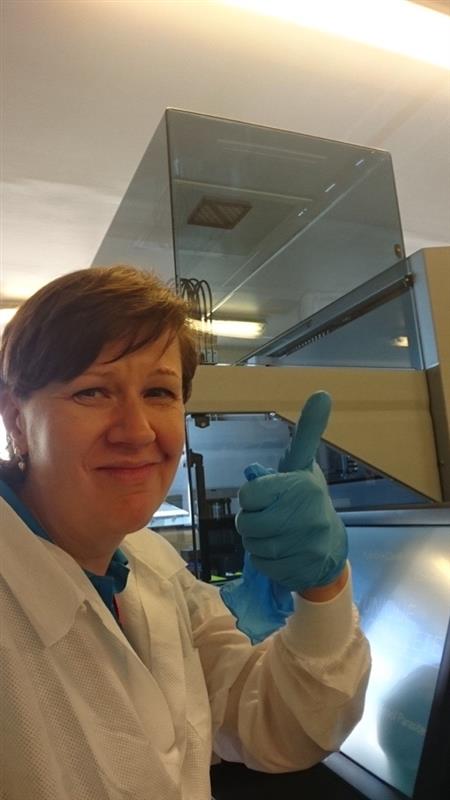
After my maternity leave, I got a position at a medical technology company. First as a senior scientist in research and development (R&D) to develop automated nucleic acid extraction and qPCR system for the diagnosis of gastrointestinal infections, followed by Technical Product Manager at Sales and Marketing (S&M). Then I returned to R&D for a couple of years and lastly worked in Human Resources (HR) as a Senior Competence and Development Specialist.
Now you have come back full circle to research and working on uterine leiomyomas! Can you briefly explain what uterine leiomyomas (ULs) are? In your opinion, why are they important to study and what are you particularly working on as part of the research?
ULs are benign tumors of the uterine wall affecting one in four women before menopause and up to 80% of pre-menopausal women. It is important to study these tumors because a portion of ULs (15-30%) cause symptoms like excessive bleeding, pain, pregnancy complications, and infertility. The severity of symptoms depends on number, size, and location of tumor(s).
The aim of my study is to find a non-invasive UL classification, which could aid in diagnosis and thus enable subclass-specific drug treatment to avoid surgery by reducing or eliminating symptoms. Currently, treatment is invasive, and ULs are the leading cause of hysterectomy.
What is the current method of diagnoses?
Currently the diagnosis is by imaging and treatment is established through multidisciplinary evaluation and patient preferences. For example, if a patient has no symptoms (asymptomatic) and no future pregnancy is desired or she is postmenopausal, no treatment necessary required.
If future pregnancy is desired, a partial surgical treatment is made (e.g. myomectomy). If the patient has symptoms and no future pregnancy is desired (or she is postmenopausal) surgical treatment i.e. hysterectomy is made.
You have experience in working with different type of tumors, gastrointestinal and respiratory infection diagnostics and have experience working in a company setting as well as research!
For those currently at a crossroad of their career path, perhaps deciding between private sector or an academic career, what has you experience been like in both fields and what would you say are the best parts and challenges of each?
In the private sector, financing was not an issue since often you were able to do experiments without worrying about tight budgets. However, there was a pressure to get the product to the market with correct timing and therefore sometimes you did not have enough time to do pre-work such as read publications.
The development of a medical device followed IVD/IVDR regulation: preparing plans, executing according to the plan, and preparing reports. Research work in the private sector was financed well but more regulated and fast-paced compared to academia. On the other hand, since there was a schedule, some projects had to be terminated, if there were issues such as lack of sample material.
From my point of view, the career paths can be different between academia and private sector. I see academia mostly as steps that you can climb. However, in the private sector there are different positions available where your personality and experience can be most useful. Therefore, career paths in the private sector can be vertical but also horizontal e.g. I have been in R&D, S&M, and HR!
I think that in both academia and the private sector, a university degree is highly appreciated but it is good to remember that work experience is just as important! You just need to know how to sell your own expertise. Moreover, those of you who are thinking the next step: there are so many possibilities; just keep open minded to different opportunities!
Want to learn more about the Finnish Center of Excellence in Tumor Genetics?
Subscribe to the blog and keep up to date with the latest posts for a peek into the everyday life in cancer research.
You can also follow us on Instagram (@tumorgenetics) and Twitter/X! (@CoEinTG)
 Tumor Genetics Blog