
By: Antti Kiviaho
Suomennos: Tervetuloa Pöytään – Mitä Olemme Oppineet Solujen Paikkatiedon Sisältävästä Datasta?
Remember the fruit tart? In early 2022, we wrote a blog post detailing the possible advantages of using spatially resolved methods to study tumors. Back then we used this simple analogy: Tumor bulk data is like a smoothie, single-cell data is like a fruit salad, but what you really want is spatially resolved data, or something like a fruit tart! By inspecting the layout you can start to piece together why some fruits are packed next to each other, how they’re oriented, and why they ended up there.
It’s now time to feast on this metaphorical fruit tart – or to take a look at what we have learned about tumors by analyzing spatially resolved data.
Spatial organization drives tumorigenesis
Cancer is a genetic disease driven by alterations in cellular DNA. While faults in the intracellular mechanisms are the final culprit behind these alterations, the tumor microenvironment plays a massive role in their genesis. Processes such as inflammation, hypoxia, and stromal interactions are only some of the cell-extrinsic factors that may tip a balanced, well-behaving cell toward the path of malignancy.
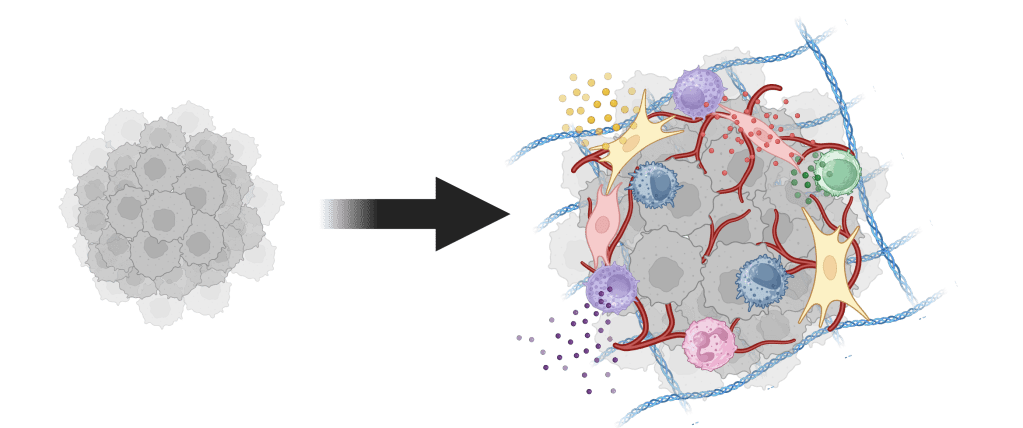
Cancer-associated fibroblasts, for instance, are not inherently malignant but are actively fueling the growth of virtually all solid tumors. In some tumors, we have come to learn the specific molecules that act as the fuel. Targeting these molecules – or shutting down the fuel pump as such – is a promising avenue for suppressing tumor growth.
Tumor-immune interactions to the limelight

A functioning immune system distinguishes between normal and foreign cells to attack the latter while sparing the former. This is not the case for tumor cells, which escape surveillance by exploiting immune checkpoint proteins. These molecules act as a “don’t eat me” signal that tricks immune cells, specifically T cells, into giving them a free pass. Some of the most successful recently discovered cancer therapies work by blocking these molecules, allowing the immune system to seek and destroy malignant cells. Here, spatially resolved technologies have revealed the tissue-level dynamics taking place during this process.
Unlikely allies – immunosuppressive myeloid cells facilitate tumor growth
Immunosuppression is another key characteristic of the tumor microenvironment that hampers the immune system’s ability to combat malignant cells. Cells in the microenvironment release a cocktail of cytokines, chemokines, and metabolites that inhibit the function of T cells. Surprisingly, this shroud of molecules is not released only by the tumor cells, but by the aptly named myeloid-derived suppressor cells, too. Myeloid cells are a part of the innate immune system acting as early responders to injury. This response is dysregulated in tumors, causing myeloid cells to accumulate, and creating a chronically inflamed microenvironment. Spatially resolved data has increased our understanding of this phenomenon, leading to better ways to battle immunosuppression in the not-so-distant future.
Identifying new interactions in the prostate tumor microenvironment
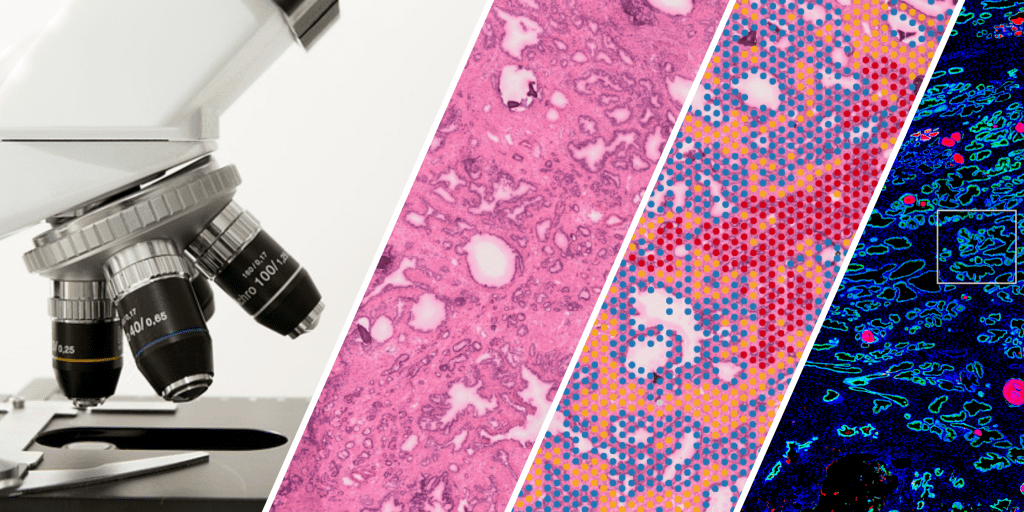
Our work in Tampere has focused on the tumor-immune interactions taking place in the prostate tumor microenvironment. In a recent research article, we used the Visium spatial transcriptomics platform to find a specialized epithelial cell subtype enriched in areas with increased immunosuppressive myeloid cell activity. These club-like epithelial cells secrete molecules that induce myeloid chemotaxis, effectively calling for the immunosuppressive myeloid cells to join them in that particular tissue region. These regions become immunosuppressive hotspots, creating the perfect storm for further tissue damage and mutations to the cellular DNA.
More please!
Although it might not feel like it, a few years is a short time in the scientific process. Breakthroughs made in spatial technologies some five to ten years ago have only recently become available to the wider research community. This means that there are numerous important discoveries still in the pipeline, the results of which are still yet to be brought to the table for us to devour.
Want to learn more about the Finnish Center of Excellence in Tumor Genetics?
Subscribe to the blog and keep up to date with the latest posts for a peek into the everyday life in cancer research. You can also follow us on Instagram (@tumorgenetics) and Twitter/X! (@CoEinTG)


One thought on “Eating the Fruit Tart – Insights Gained from Spatially Resolved Data Analysis”
Comments are closed.